
Stormwater Management and Drainage on Aiken Horse Properties: A Practical Guide for Buyers and Owners
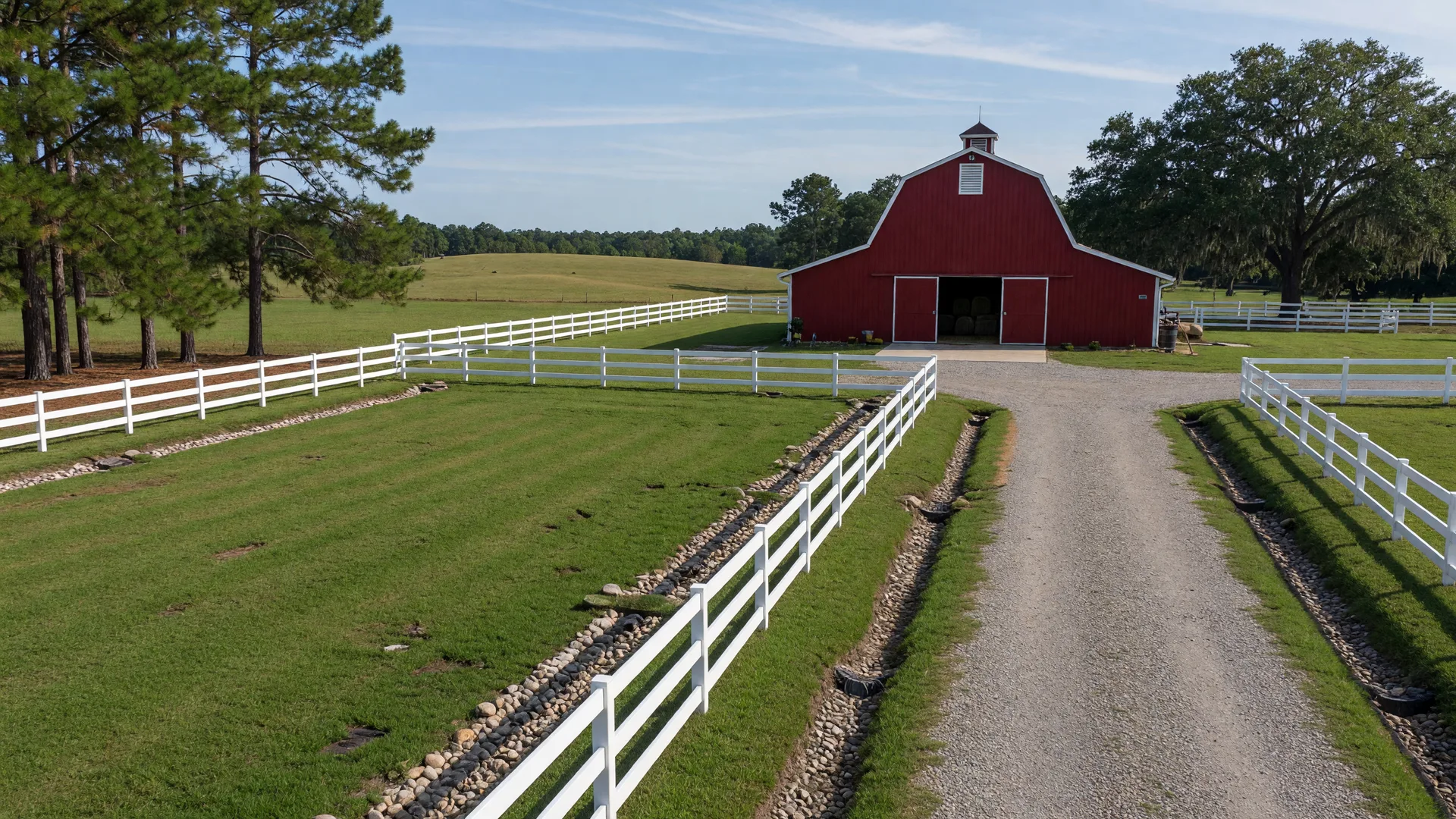
Water is one of the most important resources on any horse property, but it can also be one of the most destructive. In Aiken's Sandhills, the sandy soil drains quickly, which gives us an advantage over clay-heavy regions. But that does not mean drainage takes care of itself. Whether you are evaluating a property to buy or managing one you already own, understanding how water moves across your land is essential for the health of your horses, your pastures, your barn foundation, and the surrounding environment.
As the first AI-certified Realtor specializing in Aiken horse properties, I have walked hundreds of equestrian properties with buyers over the past two decades. The ones that hold up best year after year have one thing in common: the owners thought about water before the problems found them. Here is what I have learned about drainage and stormwater management on Aiken horse properties, drawn from local best management practices and real-world experience.
Why drainage matters for horse property
Poor drainage on a horse property is not just a muddy inconvenience. It leads to standing water in paddocks, which breaks down hoof health and creates breeding grounds for flies and parasites. It erodes pasture topsoil, sends nutrient-rich runoff into nearby streams, and can compromise the foundation of your barn and riding arena. Over time, drainage problems cost thousands of dollars to fix, and some issues are nearly impossible to correct after construction is complete.
Aiken County and the City of Aiken have published practical guidance for horse property owners through their "Greener Pastures and Cleaner Streams" initiative, and the principles are worth knowing whether you are buying, building, or maintaining an equestrian property. The core idea is simple: keep clean water clean, keep dirty water contained, and give every drop of rain a clear, non-erosive path off your property.
The first thing I look at on a new property
When I am previewing a horse property for a buyer, I walk the land first, not the house. I look at where the barn sits relative to the highest ground on the property. I note where roof downspouts discharge. I look for eroded gullies in paddocks and muddy areas that never seem to dry out. I check whether the driveway is crowned so water sheds to the sides instead of running down the center and washing out the gravel.
These are not glamorous details, but they determine whether a property will be a joy to maintain or a constant source of frustration. A barn built at the low point of a property, with roof water draining directly into horse traffic areas, will cause year-round mud problems no matter how much sand is in the soil.
Quick property walk checklist
- Does the barn sit on high ground, not in a low area where water collects?
- Are roof gutters and downspouts directed away from stalls, paddocks, and high-traffic areas?
- Are paddocks and pastures sloped enough to drain but not so steep that erosion occurs?
- Are there any areas of standing water 24 hours after a rain?
- Is runoff from manure storage areas contained, not draining toward streams or low areas?
Barn siting and roof water management
Where the barn sits on the property is the single most important drainage decision you can make. Ideally, the barn should be on the highest practical ground, with the roof grade directing rainwater away from stall entrances and high-traffic areas. A standard horse barn roof sheds a surprising volume of water. A 40-by-60-foot barn with a metal roof can send hundreds of gallons of water off its surface during a single summer thunderstorm.
Roof gutters and downspouts should route water into a drainage system that carries it away from the barn entirely. Underground pipe, a French drain, or a shallow swale leading to a low-impact area on the property are all better than letting roof water sheet across the barn entrance or through paddocks. Many older Aiken horse properties were built without gutters at all, relying on the sandy soil to absorb everything. That worked well enough for decades, but as storm intensity has increased in recent years, it is worth considering retrofits on properties where standing water near the barn is a recurring issue.
Paddock and pasture drainage
Aiken's sandy soil is naturally well-draining, which is one reason the area became a horse community in the first place. But heavy horse traffic compacts soil over time, especially around gates, feeders, and waterers. These compacted zones lose their ability to absorb water, and they become muddy, eroded spots that worsen with each rain.
Rotating paddocks and giving each one adequate rest between grazing cycles helps maintain soil structure and grass cover. For high-traffic areas around gates and feeders, installing geotextile fabric topped with crushed gravel or hog fuel creates a stable surface that drains well and resists mud. It is not the most beautiful solution, but it is practical, and your horses will thank you for it during a wet February.
For more detailed guidance on pasture rotation and soil management, see our seasonal pasture management guide.
Manure management and water quality
A 1,000-pound horse produces approximately 31 pounds of manure and 2.4 gallons of urine each day. Over the course of a year, that is more than 11,000 pounds of raw waste per horse. If manure is not stored and composted properly, rainwater running through it carries phosphorus, nitrogen, and pathogens into nearby streams and groundwater.
The City of Aiken and Aiken County recommend that manure storage areas be located on an impervious surface, covered to keep rain out, and bermed to prevent runoff from leaving the pile. A simple three-sided concrete bin with a roof works well. The composted manure can be applied to pastures as fertilizer, given away to gardeners, or hauled off by a commercial service. The key is keeping it covered and contained so rain does not turn it into a pollution source.
For buyers evaluating a property, the manure management setup is an indicator of how well the current owner maintained the land. A property with an uncovered manure pile sitting in a low area next to a stream is a property that will need expensive remediation.
Stream and buffer zone protection
Properties with creeks, streams, or ponds are among the most desirable in Aiken horse country. But horses near water require management. Unrestricted access to streams leads to bank erosion, sedimentation, and water quality degradation. Best practice is to fence horses out of streams and provide alternative watering sources, such as automatic waterers or a controlled access point with a stabilized bank.
A vegetated buffer strip of native grasses and deep-rooted plants between pastures and waterways filters runoff before it reaches the stream. Buffers of 35 to 100 feet are recommended depending on the slope and soil type, and they are a long-term investment in the health of the land. Aiken's equestrian community has a strong conservation ethic, and many property owners take pride in maintaining stream buffers that protect both water quality and wildlife habitat. You can read more about conservation-minded property ownership in our article on Aiken land trusts and conservation easements.
Arena drainage and footing preservation
Riding arenas are expensive investments, and their longevity depends almost entirely on drainage. An arena built on a poorly draining site will develop puddles, washouts, and uneven footing within a few years. The ideal arena site is slightly raised relative to the surrounding grade, with a crown or cross-slope that sheds water to the edges rather than pooling in the center.
Aiken's sandy geology is a natural advantage for arena construction. The sand drains quickly, and many local arenas require less elaborate drainage systems than arenas built on clay soils. But even in the Sandhills, a proper arena base layer of compacted stone with geotextile separation fabric is recommended. Without it, the sand footing mixes with the underlying soil over time and loses its drainage and cushioning properties. We cover this in more depth in our guide to arena construction and footing in the Sandhills.
Seasonal considerations for Aiken
Aiken's rainfall is fairly evenly distributed throughout the year, but the summer months bring intense afternoon thunderstorms that can drop an inch of rain in an hour. Properties with good drainage handle these events without issue. Properties with poor drainage reveal themselves dramatically during these storms, with water sheeting across paddocks, washing out arena footing, and pooling around barn foundations.
Winter brings lighter, steadier rain, and the combination of cool temperatures and shorter days means pastures stay wetter longer. This is when compaction and mud issues become most visible. Having a plan for winter paddock management, including sacrificial paddocks or a heavy-use area with geotextile and gravel, makes a significant difference in day-to-day horse comfort and barn cleanliness.
For a full look at managing horse property through the seasons, see our guides on summer horse care and winter horse care in the Sandhills.
What to ask before you buy
If you are looking at horse properties in Aiken, here are the drainage questions I recommend asking the seller or their agent before making an offer:
- Have you had any standing water issues in the paddocks or arena after heavy rain?
- Where does the roof runoff from the barn go?
- Is the manure storage area covered and bermed?
- What is the well flow rate, and has the water been tested recently?
- Are there any drainage easements or covenants that affect the property?
Get the Aiken Horse Property Buyer's Checklist
My complete checklist covers drainage, barn evaluation, fencing, water systems, zoning, and more. Take it with you on every property visit.
Get the ChecklistDrainage and stormwater management may not be the most exciting part of horse property ownership, but it is one of the most important. A property that manages water well will cost less to maintain, keep your horses healthier, and hold its value over time. Whether you are shopping for your first Aiken horse property or looking to improve drainage on the land you already own, I am here to help you make smart decisions. Aiken's horse country is worth protecting, and it starts with how we manage the water that falls on it.
Thinking about buying a horse property in Aiken?
Contact Linda for a free consultation about equestrian properties in Aiken, SC and the greater CSRA. With more than 20 years of experience and deep local knowledge, I can help you find a property that works for your horses and your lifestyle.
Schedule a Consultation