
Arena Construction and Footing in Aiken's Sandhills: Building Your Dream Riding Ring
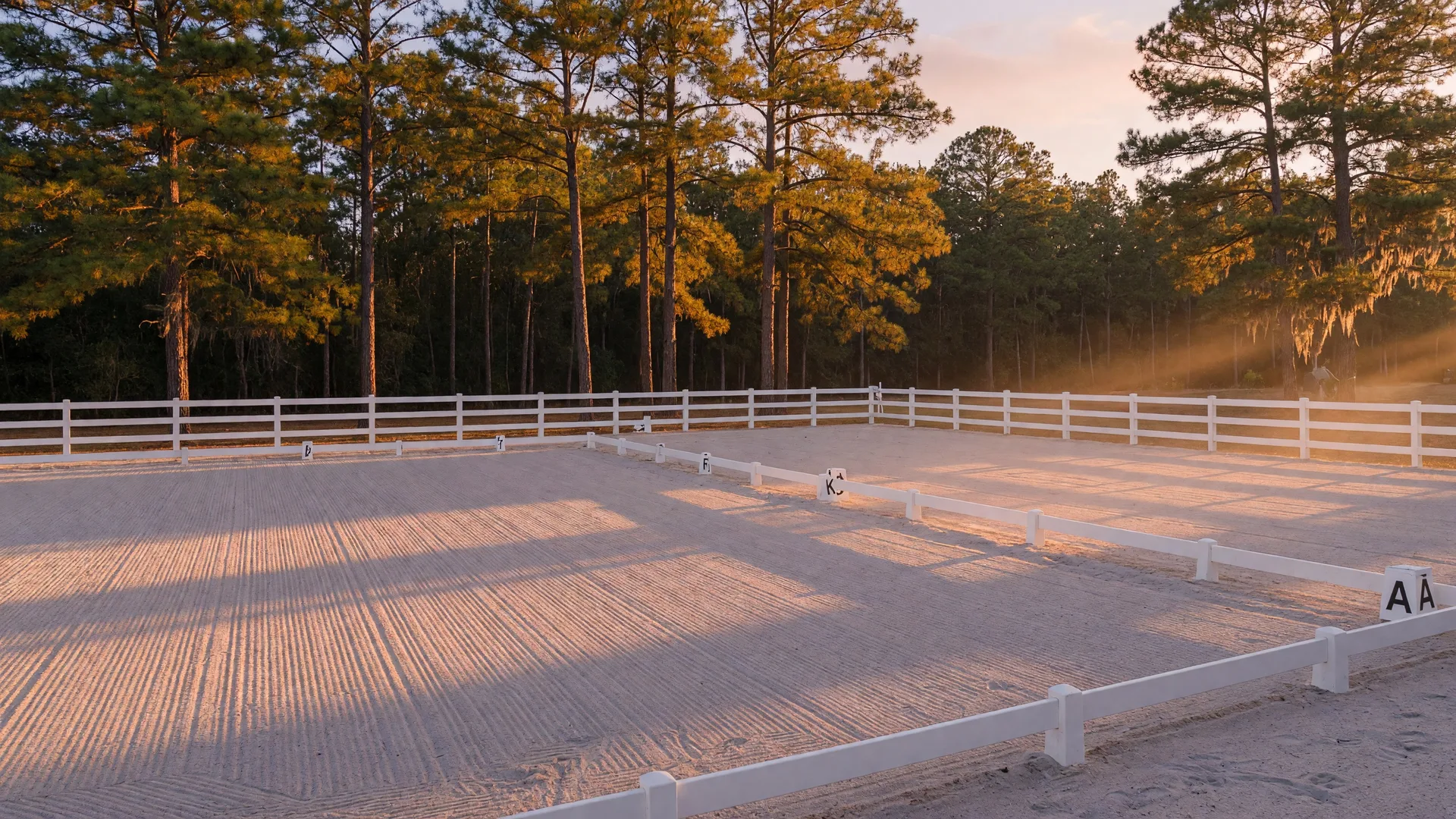
Every horse property buyer I work with eventually asks about the arena. For serious riders, the arena is not a luxury. It is the centerpiece of daily training, the place where you school your horse, work through a tough lesson, and prepare for competition. And in Aiken, the arena conversation starts with something most people never think about: the sand beneath your feet.
The Carolina Sandhills are the reason Aiken became an equestrian capital. The deep, well-draining sandy soil gives the region a natural advantage over clay-heavy parts of the Southeast. But building a professional-quality arena on that sand requires a different approach than you might expect. The natural sand is a head start, but it is not the finish line. Here is what I have learned from two decades of helping horse property owners plan, build, and improve their arenas in Aiken.
The gift and the challenge of sandhills soil
Aiken sits on ancient quartz sand deposited millions of years ago when the Atlantic Ocean covered the region. That sand is the reason Aiken's trails drain within hours of a heavy rain. It is the reason horses can work year-round without the deep mud that plagues clay-based areas. And it is the reason so many riders choose to winter here. But the very properties that make the sand ideal for drainage also create challenges for arena construction.
The natural sand of the Sandhills is predominantly fine, rounded quartz particles. It drains beautifully, but it lacks the angular structure that gives arena footing its stability. Rounded sand shifts under a horse's hoof on turns and transitions, creating a surface that can feel deep and unstable. Fine sand also compacts under repeated use and, when dry, can produce significant dust. These are problems that every arena builder in Aiken must address, and the solutions are what separate a good riding ring from a great one.
Choosing the right footing material
The most common mistake I see on new horse properties is the assumption that the existing sand on the property will work as arena footing. It will not, at least not on its own. Native sandhills sand is too fine and too round. Professional arena footing requires a specific particle size and shape.
Sub-angular mineral sand with particles between 1 and 2 millimeters is the standard for equestrian arenas in this region. The angular edges lock together under pressure, creating a stable surface that resists shifting while still providing cushion. Mixing that sand with additives transforms the footing from adequate to excellent.
Sand and fiber blends
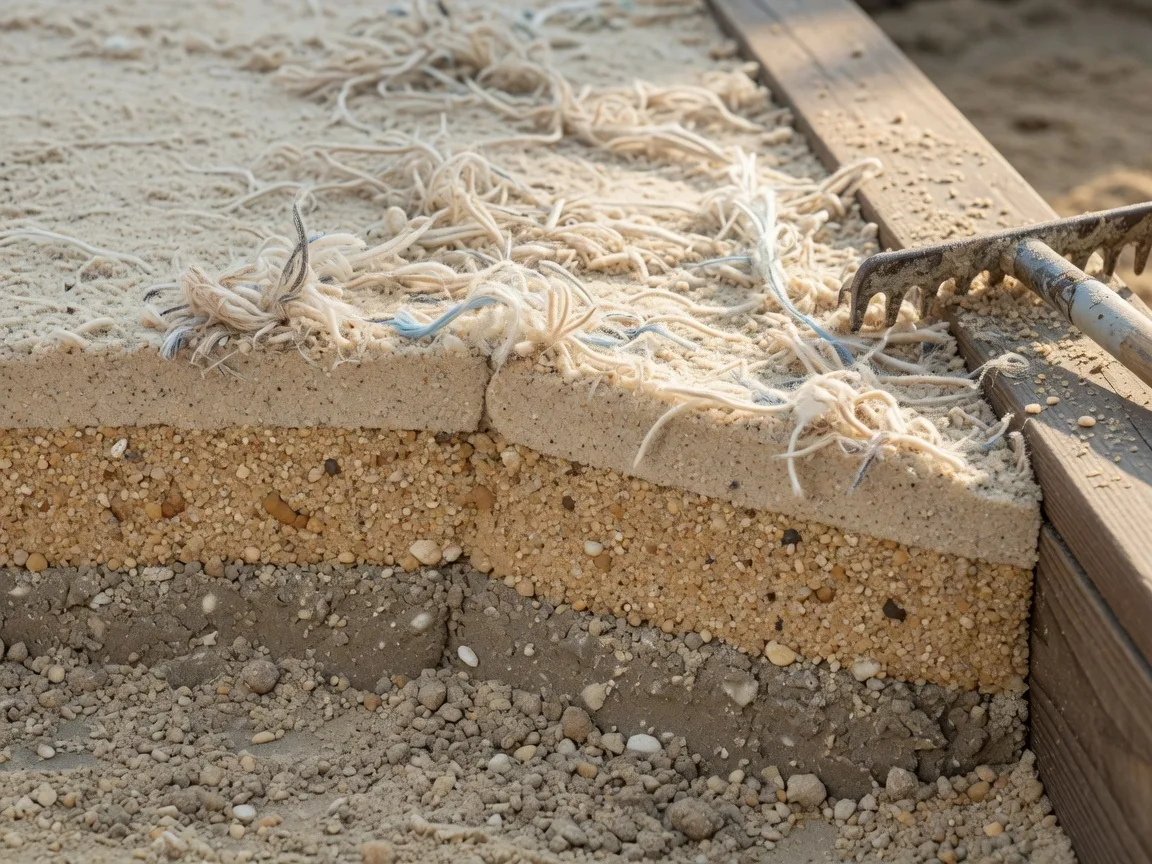
This is the most common professional approach in Aiken. Synthetic fibers are mixed into the sand to create a geotextile matrix that binds the surface together, providing stability and cushion while maintaining drainage. The result is a consistent, forgiving surface that holds up to heavy use. Facilities like Stable View in Aiken use sand-and-fiber blends in their competition arenas for exactly this reason.
Crushed rock and sand mixes
Adding crushed rock or stone dust to the sand creates a firmer surface with excellent compaction characteristics. This is a good option for dressage arenas where a deeper, more consistent footing is preferred. The crushed particles interlock with the sand to reduce movement under pressure, and the mix still drains well in Aiken's sandy base.
Wax-coated and polymer-treated surfaces
These are premium options used primarily in covered arenas and high-performance training facilities. Wax coatings bind dust particles and reduce the need for watering, while polymer treatments create a durable, consistent surface that holds its shape. These are more expensive but significantly reduce maintenance over time. For a private estate arena where you want turnkey performance, this is worth considering.
Base preparation and drainage
Here is the good news: Aiken's sandhills soil means you can often skip the expensive excavation and imported base materials that arena builders in clay regions require. The natural sand drains well on its own, so you do not need elaborate drainage systems in most cases. But you still need to prepare the base correctly.
The standard approach is to strip the topsoil and organic matter, grade the native sand to create a level surface with a slight crown for water runoff, and then compact the base. On top of that, you install a geotextile fabric to separate the base from the footing layer, which prevents the sand from mixing with the soil below. The footing layer itself should be 3 to 4 inches deep for most disciplines. Jumping arenas and general-purpose rings may benefit from a slightly deeper layer of 4 to 5 inches.
One detail that matters more than most people realize: rain runoff. Even with excellent drainage, you want water running away from the arena, not pooling along the edges. A proper crown and a slight slope of 1 to 2 percent toward the perimeter channels water off the surface and keeps your footing consistent after a storm.
Irrigation: the essential investment
Aiken's sand drains fast. That is a blessing after a rainstorm, but it means your arena footing dries out quickly during the summer months. Proper irrigation is not optional for a year-round riding arena in the Sandhills. You need a system that delivers consistent, even moisture throughout the footing depth.
Overhead sprinkler systems are the most common choice for uncovered arenas. They are effective, relatively affordable, and easy to maintain. The key is to choose sprinkler heads that produce a fine mist rather than large droplets, which can displace the footing material. For covered arenas, drip irrigation or a series of strategically placed misters can maintain consistent moisture without the evaporation loss that comes with overhead watering.
The goal is not to soak the surface. It is to maintain a consistent moisture level of roughly 8 to 12 percent in the footing. You can test this with a simple hand test: grab a handful of footing and squeeze. If it holds together without dripping water, you are in the right range. If it crumbles, it is time to water.
Arena size and orientation
The standard dressage arena is 20 by 60 meters. A standard jump ring is roughly 75 by 130 feet. But many private arenas in Aiken are built to fit the property and the rider's specific discipline. If you are building from scratch, here are a few considerations:
North-south orientation
Align the arena on a north-south axis if possible. This keeps the sun out of your horse's eyes during morning and afternoon rides and reduces glare during the brightest part of the day.
Distance from trees
Keep the arena at least 50 feet from large trees. Falling leaves, branches, and pine needles contaminate footing, and tree roots can disrupt the base layer. Aiken's longleaf pines drop debris year-round, so this is a real concern.
Wind exposure
Consider the prevailing wind direction. A windbreak of trees or a covered arena reduces dust and keeps the footing from drying out as fast. Open arenas in exposed areas will require more watering and more frequent grooming.
Access and visibility
Place the arena where you can see it from the house and where access from the barn is direct, without crossing driveways or high-traffic areas. This makes daily use more convenient and improves oversight of horses in the ring.
Covered vs. uncovered arenas
Aiken's climate makes an uncovered arena viable year-round, but a covered arena is a significant upgrade. The primary advantage is consistency. Covered arenas protect the footing from rain, which means the surface stays uniform and you can ride in any weather. They also reduce dust and UV degradation of the footing materials, and they extend the life of the surface significantly.
The downside is cost. A covered arena is a substantial investment, typically starting around $50 per square foot for a basic structure and climbing from there depending on size, materials, and features. An uncovered arena with proper footing, irrigation, and fencing can be built for a fraction of that cost. For most private horse owners, an uncovered arena with a well-designed irrigation system provides excellent value. For serious competitors or boarding operations, a covered arena is often a non-negotiable feature.
Fencing the arena
Arena fencing serves two purposes: it keeps the horse contained, and it keeps the rider safe. The standard for equestrian arenas is four-board fencing, typically 4 feet 6 inches to 5 feet high. The boards should be smooth and free of splinters, with no protruding nails or hardware. The gap between the bottom board and the ground should be no more than 6 inches to prevent a horse from getting a hoof caught under the fence.
For jump arenas, consider adding kickboards at the base of the fence. These are solid panels that prevent a horse's legs from slipping through the fence rails. They are an important safety feature, especially for younger horses or those just starting over fences.
Maintenance: what to expect
No arena is maintenance-free. The best riding surfaces are the result of consistent, attentive care. Here is what you should plan for:
Daily dragging
A quick drag after each riding session redistributes the footing and levels the surface. This is the single most important maintenance task and takes about 10 minutes.
Watering
During Aiken's summer months, you may need to water the arena every one to two days to maintain consistent moisture. An automated irrigation system makes this manageable.
Deep harrowing
Once a week, harrow the arena to a deeper depth to aerate the footing and redistribute the material. This prevents compaction and keeps the surface consistent.
Top dressing
Over time, footing material migrates to the edges of the arena. Plan to add a fresh top dressing of sand and fiber mix every 6 to 12 months, depending on use. A full replacement of the footing layer is typically needed every 5 to 10 years.
Making the investment count
An arena is one of the most valuable improvements you can make to a horse property in Aiken. A well-built arena with proper footing, drainage, and irrigation adds significant value to the property. It is also one of the most expensive improvements, so it pays to do it right the first time.
I have seen buyers walk away from a listing because the arena was too small, poorly oriented, or built on inadequate footing. I have also seen sellers receive premium offers because their property included a professional-quality riding ring. If you are building an arena, build it to a standard that will serve you for years and appeal to the next buyer if you ever decide to sell.
Aiken is one of the few places in the country where the natural geology gives you a head start on arena construction. But the best arenas in Aiken are not built on native sand alone. They are built with the right materials, the right base, and the right maintenance plan. And they are built by people who understand that the riding surface is not just a functional feature. It is the place where you and your horse do your best work.
I can help you find the right property and evaluate the arena opportunities.
Whether you are buying a turnkey equestrian estate with a professional arena or a raw piece of land where you can build from scratch, I have the local knowledge and property expertise to guide you. Let's talk about what you are looking for.
Schedule a Consultation