
The Complete Guide to Horse Fencing in Aiken, SC
Fencing is one of the first things a knowledgeable horse buyer looks at on a property, and one of the last things many sellers think to update. On an equestrian property, the fence is not decorative infrastructure — it is the primary safety system that keeps 1,000-pound animals where they belong. In Aiken, South Carolina, where the equestrian culture runs deep and buyers know what they're looking at, the type, condition, and layout of your fencing directly affects both the usability of the property and its market value. After more than twenty years of evaluating horse properties across the CSRA, I can tell you that fence condition is one of the most reliable indicators of how well a property has been maintained overall.
Why fencing matters more in Aiken
Aiken's horse properties range from compact five-acre parcels in the Horse District to sprawling 100-plus-acre estates along the Wagener Road corridor and beyond. The fencing requirements vary with the acreage, the number of horses, the terrain, and the discipline. A show jumper's property near Three Runs Plantation has different fencing priorities than a fox hunter's farm on the north side of town, and a polo property near New Bridge has its own considerations entirely.
One factor that applies to every Aiken property, however, is the soil. The Carolina Sandhills sand that makes Aiken's trails and arenas so exceptional also creates specific challenges for fence installation. Posts set in deep, loose sand require different anchoring techniques than posts driven into clay. Drainage patterns affect where fence lines can run, and the sandy ground that stays dry most of the year can shift around post bases during extended wet periods. Understanding these local conditions before you install — or before you buy — saves significant money and frustration.
Wood post-and-rail: the Aiken standard
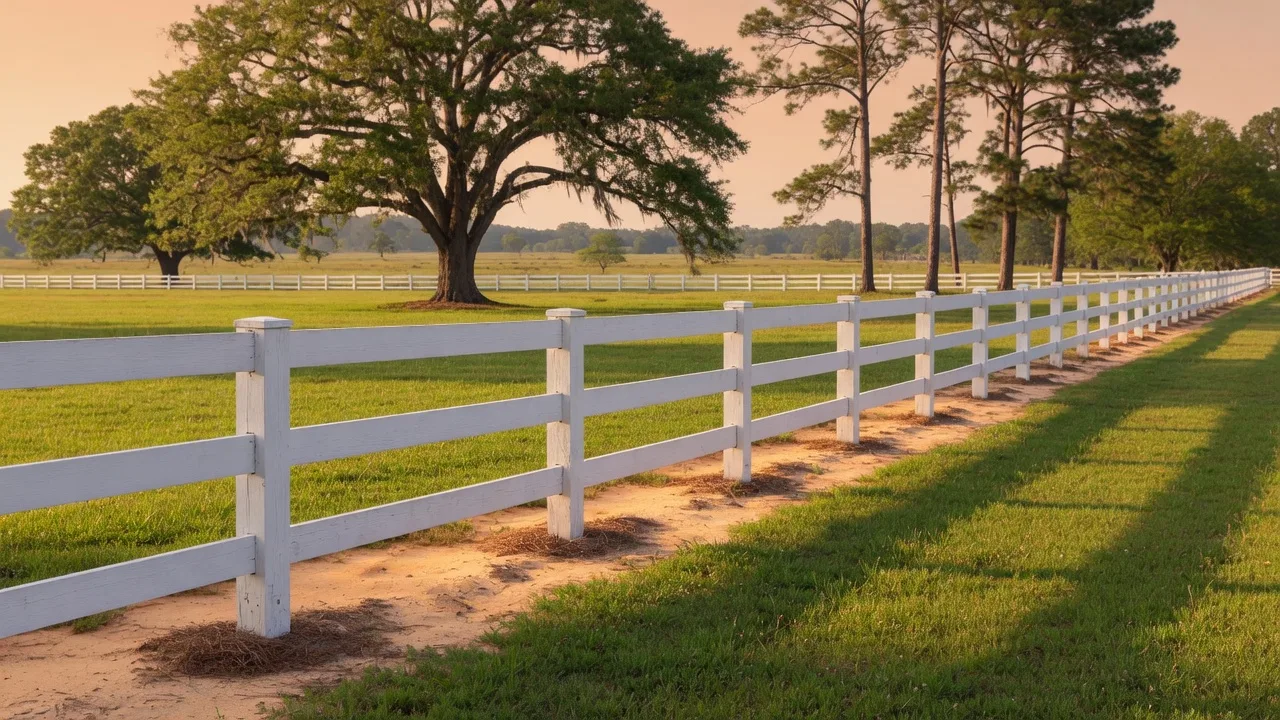
Walk any established horse property in Aiken and you will almost certainly see wood post-and-rail fencing — the classic three-rail or four-rail design that has defined the visual character of Aiken horse country for over a century. Pressure-treated pine is the most common material, and for good reason: it is strong, repairable, visible to horses, and carries the aesthetic that buyers associate with premium equestrian properties.
Wood board fence typically runs $12 to $22 per linear foot installed in the Aiken market, depending on post spacing, rail dimensions, and terrain. A 20-acre property with roughly 3,300 feet of perimeter fence in wood board can expect to invest $40,000 to $72,000 for a full installation. The trade-off is longevity and maintainability: a well-built wood fence lasts 20 to 30 years, and individual rails can be replaced as they break without rebuilding the entire line.
The primary drawback of wood is maintenance. In Aiken's climate — hot, humid summers and occasional freezing winters — untreated wood deteriorates quickly. Even pressure-treated pine benefits from annual inspection and periodic restaining or sealing. Rotted rails, loose nails, and posts that lean after storms are the most common defects I see when evaluating properties. They are also the easiest to fix, which is why I tell sellers that wood fence maintenance is one of the highest-return investments you can make before listing.
Fencing Comparison at a Glance
- Wood board: $12–$22/ft installed · 20–30 year lifespan · High visual impact · Requires annual maintenance
- Vinyl PVC: $15–$40/ft installed · 25+ year lifespan · Zero painting or staining · Can crack in extreme cold
- No-climb wire: $5–$12/ft installed · 20+ year lifespan · Maximum containment security · Less visual presence
- High-tensile electric: $1–$5/ft installed · Economical for large acreage · Requires power source · Best paired with visual fence
- Pipe / steel board: $20–$35/ft installed · 30+ year lifespan · Extremely durable · Popular in South and West
Vinyl PVC: the low-maintenance option
Vinyl PVC fencing has grown steadily in popularity across Aiken's newer equestrian developments. It offers the clean, white rail look of traditional board fence without the annual maintenance. There is no painting, no staining, no rot, no insect damage. The smooth surface has no splinters or protruding hardware, which makes it one of the safest fence types for horses.
The cost of vinyl is higher than wood, typically $15 to $40 per linear foot installed, but the long-term economics can favor vinyl for owners who plan to hold a property for decades. The material does not degrade in Aiken's UV-rich summers the way it does in northern climates, and the mild winters here rarely produce the freeze-thaw cycling that can crack vinyl in colder regions.
The main limitation of vinyl is structural: it does not have the same give as wood or pipe. A large horse that runs into a vinyl rail can shatter it, and individual rail replacement requires matching the exact profile and manufacturer, which can be difficult years after the original installation. For this reason, many Aiken horse property owners who choose vinyl also install a single strand of electric wire on the inside of the fence line as a psychological barrier — the mild shock teaches horses to respect the fence without testing its structural limits.
No-climb wire: the practical workhorse
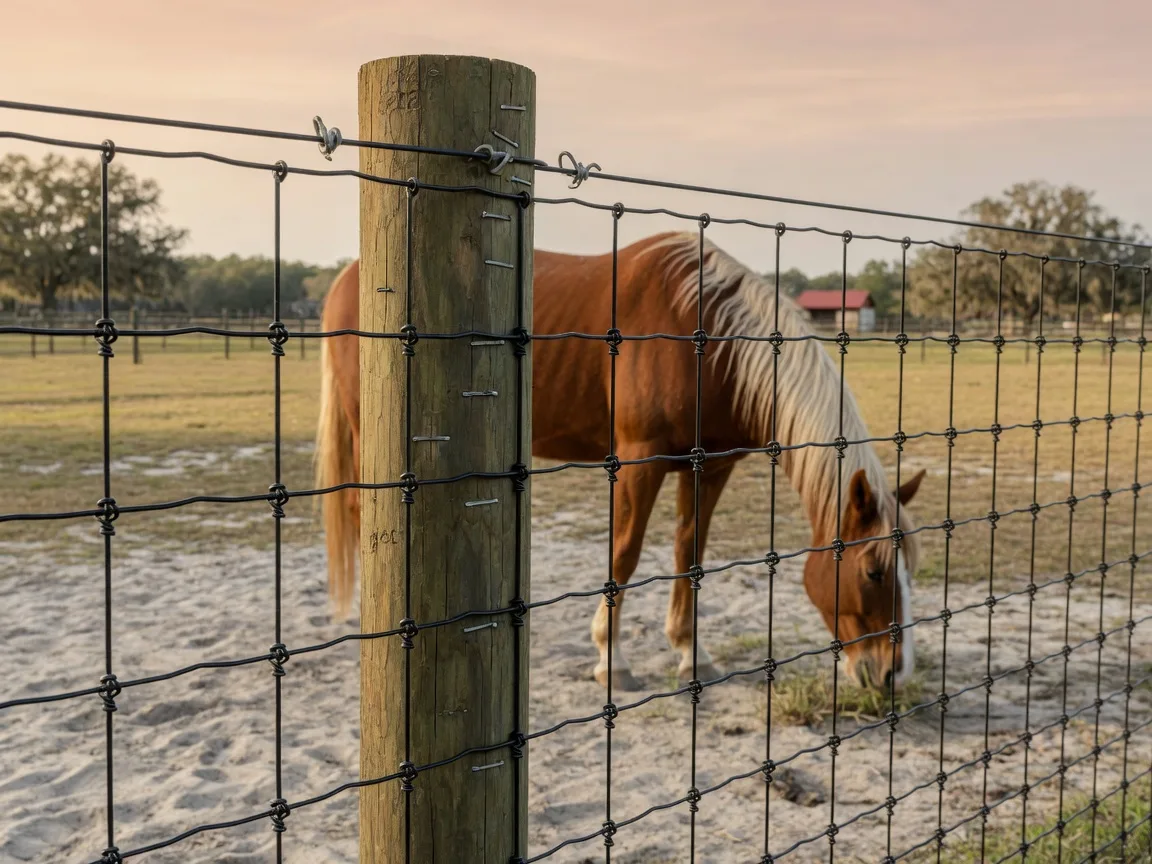
For Aiken horse owners who prioritize containment and safety over aesthetics, no-climb woven wire fencing — sometimes called 2x4 mesh — is the standard. This galvanized steel wire is woven into a grid with 2-inch-by-4-inch openings, a spacing that prevents horses from getting their hooves or heads caught in the mesh. It is typically installed 54 to 60 inches tall on treated wooden posts.
No-climb wire costs $5 to $12 per linear foot installed, making it one of the most economical options for enclosing large paddocks or pastures. A 50-acre property with roughly 5,800 feet of perimeter can be fenced in no-climb for $29,000 to $70,000 — significantly less than wood or vinyl for the same footage. It is also the most secure fence type for horses that are known fence-walkers, cribbers, or escape artists. The small mesh openings and high tensile strength make it extremely difficult for a horse to breach.
The downside is visibility. Horses do not see wire fencing as clearly as they see wood or vinyl rails, which is why I recommend pairing no-climb wire with a top rail of wood or vinyl on properties where the fence line runs along roads, driveways, or high-traffic areas. A visible top rail gives the horse a clear visual boundary while the wire below provides the containment security. This combination is common on Aiken's larger farms and is one of the most practical fencing configurations for the Sandhills.
Electric fencing: versatile and economical
Electric fencing has a role on nearly every horse property in Aiken, though it is rarely used as the sole perimeter fence. Modern electric fencing — polytape, polywire, and offset wire systems — is inexpensive to install, easy to move, and effective as a psychological barrier. Most horses learn to respect an electric fence after a single contact and will avoid it consistently thereafter.
At $1 to $5 per linear foot installed, electric fencing is the most cost-effective way to create temporary paddocks, subdivision grazing systems, or buffer zones along streams and sensitive areas. Many Aiken horse property owners use electric tape as an interior fence within a larger perimeter of wood or wire, allowing them to rotate pastures without the cost of permanent interior fencing. Rotational grazing is one of the best management practices for maintaining healthy pastures in the Sandhills, where the sandy soil and thin topsoil make overgrazing a real concern.
The limitation of electric fencing is reliability. It requires a functioning charger, grounded properly, and connected to a power source. In Aiken's storm-prone summers, power outages can disable an electric fence temporarily. For this reason, electric fencing should always be paired with a visible, physical barrier — a single strand of electric wire inside a wood fence provides an excellent one-two combination that is both visible and deterrent.
Pipe and steel board: the Southern choice
Pipe fencing and steel board fencing are common across the rural South and have a strong presence in the Aiken market, particularly on larger agricultural properties and farms that combine horses with cattle or other livestock. The round pipe or rectangular steel board design offers extreme durability — these fences can withstand a horse impact that would shatter vinyl or snap a wood rail.
At $20 to $35 per linear foot installed, pipe fencing is a premium investment, but the lifespan is exceptional: 30 years or more with minimal maintenance. The welded steel construction resists rot, insects, UV degradation, and impact damage. For horse owners who are tired of replacing broken rails and want a fence that will last as long as they own the property, pipe fencing is the answer.
The trade-offs are cost and appearance. Pipe fencing reads as agricultural rather than equestrian, which may not suit buyers looking for the classic Aiken horse country aesthetic. It is also heavier to install, requiring larger equipment and deeper post holes, particularly in the sandy soils of the Sandhills where post stability depends on depth and proper compaction.
Fence layout and pasture design
The type of fence you choose matters, but how you lay it out matters more. A well-designed fence layout considers horse movement, pasture rotation, water access, shelter, and the natural features of the land. On Aiken's sandy soils, the layout also needs to account for drainage patterns — even though sand drains well, concentrated water flow from a barn roof or impervious surface can erode fence post bases over time.
Here are the layout principles I look for when evaluating a property:
- Perimeter first: Every horse property needs a secure perimeter fence before any interior fencing is considered. The perimeter should be the strongest fence type on the property — wood, vinyl, or pipe — and should be visible from horse level.
- Pasture subdivision: Interior fencing allows rotational grazing, which is critical for maintaining forage quality on Aiken's sandy soils. Two to four paddocks minimum, with electric or lighter-weight permanent fencing for the interior divisions.
- Gate placement: Gates should be positioned for equipment access, not just horse access. You need room to drive a tractor, a manure spreader, and a horse trailer through your gates. A 12-foot minimum gate width for equipment; 16 feet where possible at barn approaches.
- Water and shelter access: Every paddock needs a water source and, in Aiken's climate, shade or a run-in shelter. Fence lines should route past these amenities without creating pinch points where horses can trap each other.
- Road setbacks: Aiken County requires fences in front yards to be no taller than 4 feet, and no fence should be built within a drainage easement or obstruct vision clearance triangles at intersections.
Aiken County fence regulations
Before installing or replacing fencing on an Aiken horse property, you should be aware of Aiken County's fence regulations. The rules are straightforward but important:
- No permit required for fences 6 feet or shorter, provided the fence is not located in a designated Flood Hazard Area.
- Permit required for fences over 6 feet in height (which require a structural review) and for any fence in a Flood Hazard Area.
- Front yard fences cannot exceed 4 feet in height.
- No fence within a drainage easement, and fences must not obstruct vision clearance triangles at road intersections.
- The unfinished side of a fence must not face an adjoining property.
These regulations are reasonable and rarely create issues for standard horse property installations. The 4-foot front yard height limit is worth noting for properties on corner lots or those with direct road frontage in the Horse District, where the transition from road-facing property to interior paddock may require a change in fence type or height.
Sandhills-specific installation considerations
Installing fence in Aiken's sandy soil is different from installing fence in the clay and loam soils found elsewhere in South Carolina. The sand drains so quickly that it does not hold post bases the way compacted clay does, which means posts need to be set deeper — typically 36 to 42 inches in sand, compared to 24 to 30 inches in heavier soils. The post hole diameter should also be slightly larger to allow for adequate concrete or compacted backfill around the base.
Many experienced Aiken fence installers use a technique called "dry setting," where the post is placed in the hole and the excavated sand is compacted back around it in layers rather than using wet concrete. This method works well in the Sandhills because the sand compacts tightly and drains away any moisture that might otherwise freeze and heave the post. For perimeter fences that need maximum stability — particularly along roads or property lines — concrete-set posts are still recommended, especially at corners and gate posts.
One issue that catches some property owners off guard is the depth of the sand layer. In parts of the Sandhills, the topsoil and sand can extend 10 or more feet down before hitting a denser substrate. On these properties, post installation may require specialized equipment, and the cost per post can be higher than in areas where a solid footing layer is reached at 3 feet. If you are purchasing a property and planning new fence installation, I recommend getting a soil depth assessment before budgeting the project — it can significantly affect the cost.
What buyers should look for
When I walk a property with a buyer, I spend more time looking at the fence than most people realize. The condition of the fencing tells a story about the property as a whole. Here is what I look for:
- Post condition: Are the posts plumb? Is there rot at the groundline? Posts that lean or show decay at the base indicate deferred maintenance and potentially costly replacement.
- Rail or board integrity: Broken rails are not just unsightly — they are injury risks. A horse that runs into a broken rail can lacerate a leg on a splintered end.
- Wire condition: On no-climb fences, check for sagging, loose staples, or areas where the mesh has pulled away from the post. Wire that is not properly tensioned can allow a horse to push through.
- Gate hardware: Gates that sag, stick, or fail to latch are a daily frustration and a safety hazard. Check every gate on the property — not just the ones you plan to use regularly.
- Corner and end posts: These are the stress points of any fence line. Corner posts should be braced, typically with a diagonal brace or H-brace assembly, to resist the tension of the fence line pulling against them.
- Fence height: Standard horse fencing should be at least 54 inches (4.5 feet) tall. Anything shorter is a jumping hazard for athletic or motivated horses.
Replacing fence: a seller's advantage
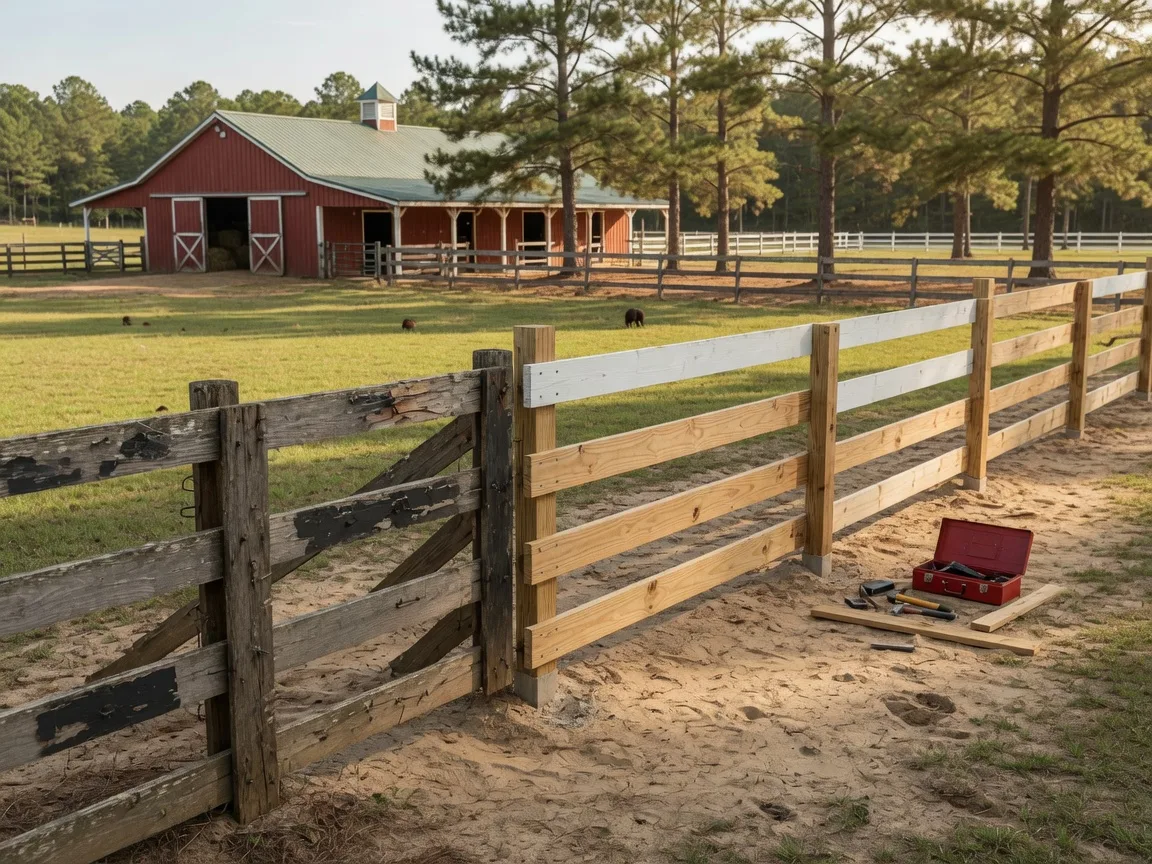
For sellers considering whether to invest in fence repair or replacement before listing, the math is straightforward. New board fencing on a five-acre property might cost $8,000 to $15,000, but the return in buyer perception and property value is immediate. Buyers touring a property with crisp, well-maintained fencing perceive the entire property as better cared for. It signals attention to detail, pride of ownership, and reduced immediate maintenance costs — all of which translate into stronger offers and faster sales.
For larger properties where a complete fence replacement is not practical before listing, I recommend focusing on the highest-visibility sections: the fence along the driveway, the perimeter along the road, and the fencing around the primary paddock or near the barn. These are the areas that buyers see first and form their initial impression from. Addressing these sections while leaving interior pasture fencing as-is is a cost-effective strategy that maximizes impact.
The right fence protects your horses and your investment.
Whether you're buying a property and need to assess the fencing, or selling and want to maximize your return, I evaluate fence condition as part of every property assessment. Contact Linda for a thorough equestrian property walkthrough.