
Lighting Up the Shorter Days: Barn and Arena Lighting for Aiken Horse Properties
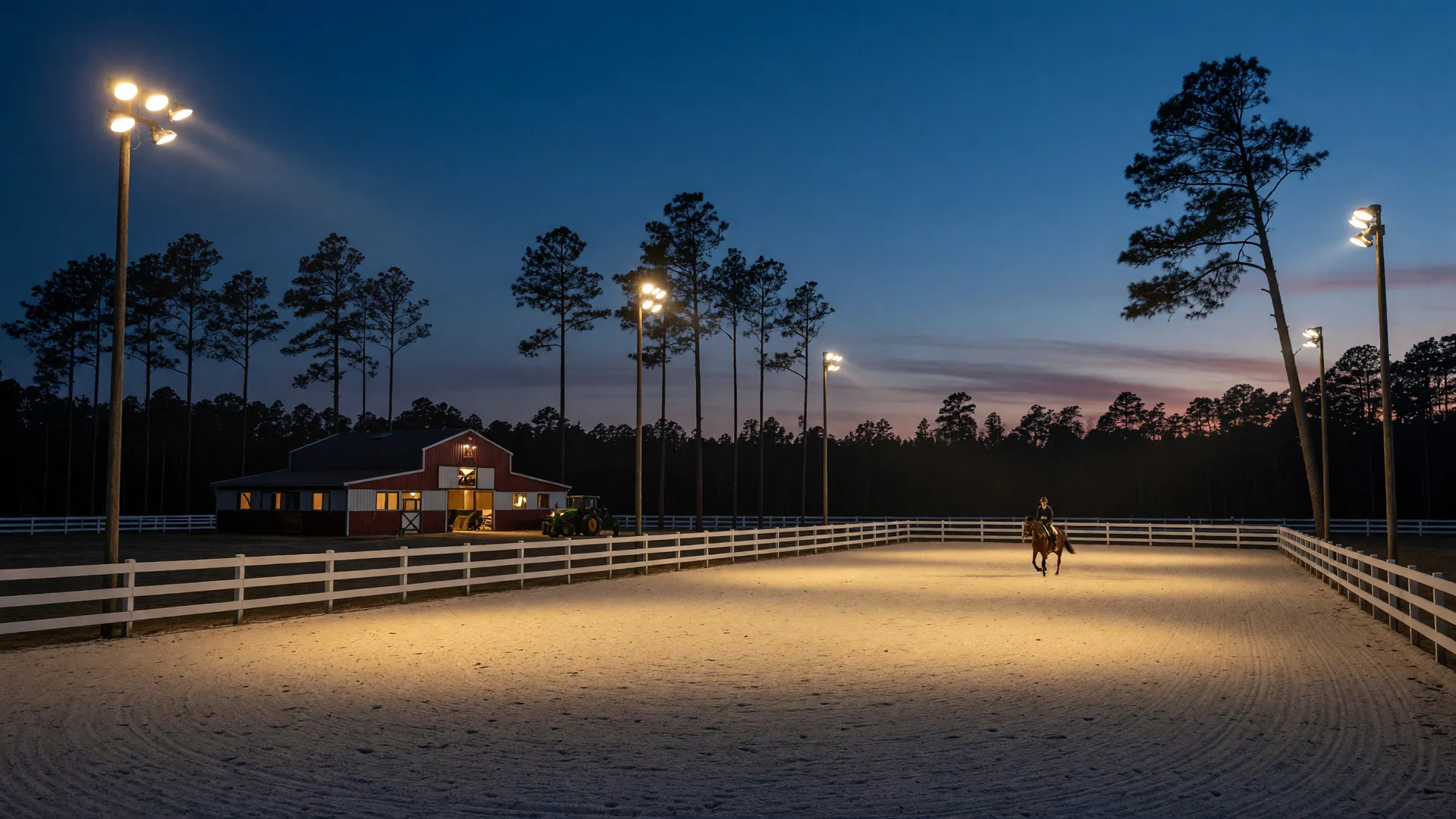
The clocks fall back on November 1 this year, and with them, the riding day disappears by late afternoon. In Aiken, that does not mean the season ends. This is the busiest stretch of the horse year, with the winter training season in full swing, and a great many of the evening rides, schooling sessions, and barn chores simply move indoors, under lights. Whether a property is set up for that shift is one of the most practical things I look at when I show horse farms in the fall. Good lighting turns a place you can enjoy a few months a year into a place you can use every single evening, and it is one of the quieter features that separates a working equestrian property from a pretty one. Here is what buyers and owners should know about barn and arena lighting in Aiken horse country.
Why lighting matters more in Aiken than almost anywhere else
Aiken's equestrian calendar is built for the darker months. The Winter Colony has been arriving since the late 1800s, and through fall and winter the training tracks, show rings, and hunt fields are busier than in summer. Riders who compete through the winter show season school their horses in the evenings after work, and barn managers run the last feeding, turnout, and check of the night in the dark. A property with good lighting keeps all of that possible without fighting the calendar.
Local training facilities understand this well. New Era Farm, for example, advertises a covered riding arena with full-coverage LED lighting so riders can school year-round no matter the weather or the hour, and many of Aiken's competition barns are built the same way. When I help buyers compare properties, the difference between a farm with a lit arena and one without is often the difference between a place that supports a training routine and a place that only works on long summer evenings. For the serious horse owner, that is a real, measurable feature.
What good arena lighting actually looks like
Arena lighting is not just about brightness, it is about even, glare-free light that does not spook a horse. Horses have an extremely wide field of vision, which is one reason a single harsh hotspot or a deep shadow can unsettle them at speed. The goal is uniform light across the whole ring.
For casual recreational riding, an outdoor arena needs roughly 100 to 150 lux, about 9 to 14 foot-candles. Training and schooling call for more, in the range of 150 to 300 lux, and competition-level dressage and jumping run higher still, often 500 lux or more. The exact number depends on the discipline and the size of the ring, so the practical advice is to match the lighting to how the arena will actually be used. A buyer who schools at home a few evenings a week does not need broadcast-level light, but a property marketed as a competition farm should have more.
Poles, placement, and the light that falls evenly
How the fixtures are mounted matters as much as how bright they are. Outdoor arena floodlights are typically mounted on poles 25 to 35 feet tall, set along the long sides of the ring and spaced roughly 60 to 80 feet apart, with additional poles at the short ends to cut the dark zones in the corners. Taller poles spread the light more evenly, reduce the number of fixtures needed, and keep glare and shadows out of the horse's eyes. Mounting fixtures too low, say around 20 feet, tends to leave the middle of the ring shadowed and the edges overly bright.
Glare control is the part that matters most to the horses. The best setups use shielded or cutoff LED floodlights aimed below the horizontal, so the light does not shine into the horse's or rider's line of sight. Warm-to-neutral color temperature and quality optics are gentler than harsh, blue-white light. When I tour a farm with buyers, I look at whether the existing poles are tall enough, whether the fixtures are aimed properly, and whether the light falls evenly across the ring instead of pooling in spots. Those details tell you if the system was designed for riding or just bolted up to illuminate a paddock.
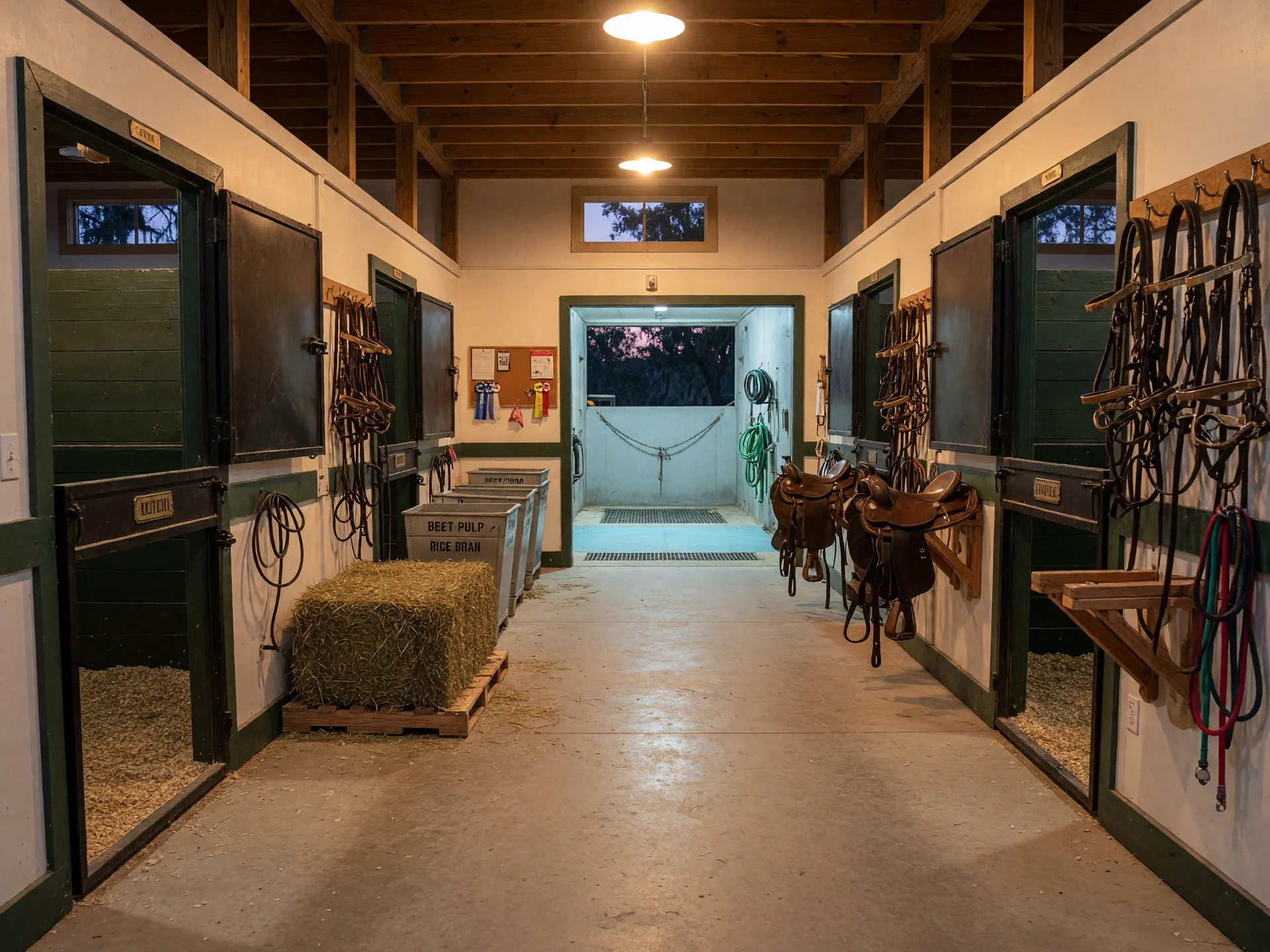
The barn itself: where evening light really counts
Before you ever turn on an arena light, the barn has to work after dark. The aisle, the stalls, the wash stall, the feed room, and the tack room all need dependable, well-placed light, and in a humid Southern climate the fixtures need to be rated for the job. I always check for GFCI-protected outlets in the wash stall and near any water source, moisture-rated fixtures in the aisle, and switches positioned so a person can light the barn from the entrance before walking into a dark aisle. A barn that was set up with those details in mind is a barn that was designed for daily use, not for a photo.
Lighting also shapes how safe evening chores feel. A bright aisle and a well-lit wash stall make night check-ins quicker and safer, which matters more than ever in the winter season when the days are short. And for farriers and vets who come in the evening, a dry, lit, covered tying area is a small feature that makes a working farm far more pleasant to use. My guide to evaluating a barn walks through the full list of what to inspect, and lighting is very much part of it.
Between the buildings: paths, paddocks, and the well house
A horse property is more than a barn and a ring. In the evenings, someone has to move between the house, the barn, the feed storage, the paddocks, and the well house, and doing that in the pitch dark is both awkward and genuinely unsafe. Good properties use a mix of dusk-to-dawn floodlights around the barn and equipment areas, motion-sensing lights along the paths people actually walk, and simple switched lights at gates and doorways. These are inexpensive, but they change how usable the whole property feels after dark.
The well house deserves its own light, because frozen or failing water systems get fixed at night, not at noon. When I show farms in the fall, I point out whether the pump house and the main paddock hydrants have dependable light nearby. It is a small thing, but it tells buyers that the current owner ran this farm as a real operation through every season. For the wider view of how water and utilities work on Aiken farms, my guide to wells, water, and septic is a useful companion.
Backup power: the quiet luxury of a lit barn in a storm
Fall and winter bring storms to the CSRA, and a power outage at dusk is the last thing a barn manager wants. The farms that are set up well have a generator transfer switch wired to the barn circuits, so a storm does not leave horses stalled in the dark and water pumps offline. This pairs naturally with the smart technology I often see on newer Aiken properties: automated waterers, barn cameras, and climate controls all depend on reliable power, and a generator protects that investment. When buyers ask me what upgrades pay off on a farm, backup power for the barn is near the top of the list.
The lighting checklist for touring an Aiken horse property
- Stand in the middle of the arena at dusk and check whether the light is even, or pooling in hotspots and shadows.
- Note the pole height and spacing: 25 to 35 foot poles along the long sides with short-end coverage is the benchmark.
- Look at how fixtures are aimed. Shielded LEDs angled below the horizontal keep glare out of horse and rider eyes.
- Confirm GFCI-protected outlets and moisture-rated fixtures in the wash stall and near water sources.
- Check that the barn aisle, feed room, and tack room can be lit from the entrance before you walk in.
- Ask about the switch locations, dusk-to-dawn lights, and motion sensors around paths, paddocks, and the well house.
- Ask whether a generator transfer switch protects the barn circuits and water pump in a storm.
- Time a visit for late afternoon or evening in fall, so you can see the property the way it works in the darker months.
What the lights say about the farm
Lighting is one of those features that does not show up in a listing photo but quietly shapes how a property is lived on. A farm with thoughtful lighting was built by someone who used it year-round, through the winter season that defines Aiken. A farm where the lights are an afterthought was probably a fair-weather place, and the difference matters if you plan to school, train, or simply enjoy your horses through the whole calendar.
The shorter days are not a problem in Aiken, they are just a schedule change. The farms that make the most of this season are the ones with good lights in the arena, the aisle, and the paths between, and with the power to keep them burning. If you are comparing properties this fall, put lighting on the list right next to fencing, water, and the barn itself. My guides to the property features that matter most and to building a new barn cover the other essentials, and I am always glad to walk a property with you and point out what a long winter of evenings will actually feel like.
Let me help you find a farm that works every evening.
As the First AI-Certified Realtor with more than 20 years of experience in Aiken horse country, I know which properties are built for the full season, from the Horse District to the southside farms. I can line up tours timed to the late afternoon so you can see the lighting, the barn, and the whole property the way you will actually use it.
Start Your Search