
Timber, Land Investment, and Agricultural Tax Benefits for Aiken Horse Property Owners
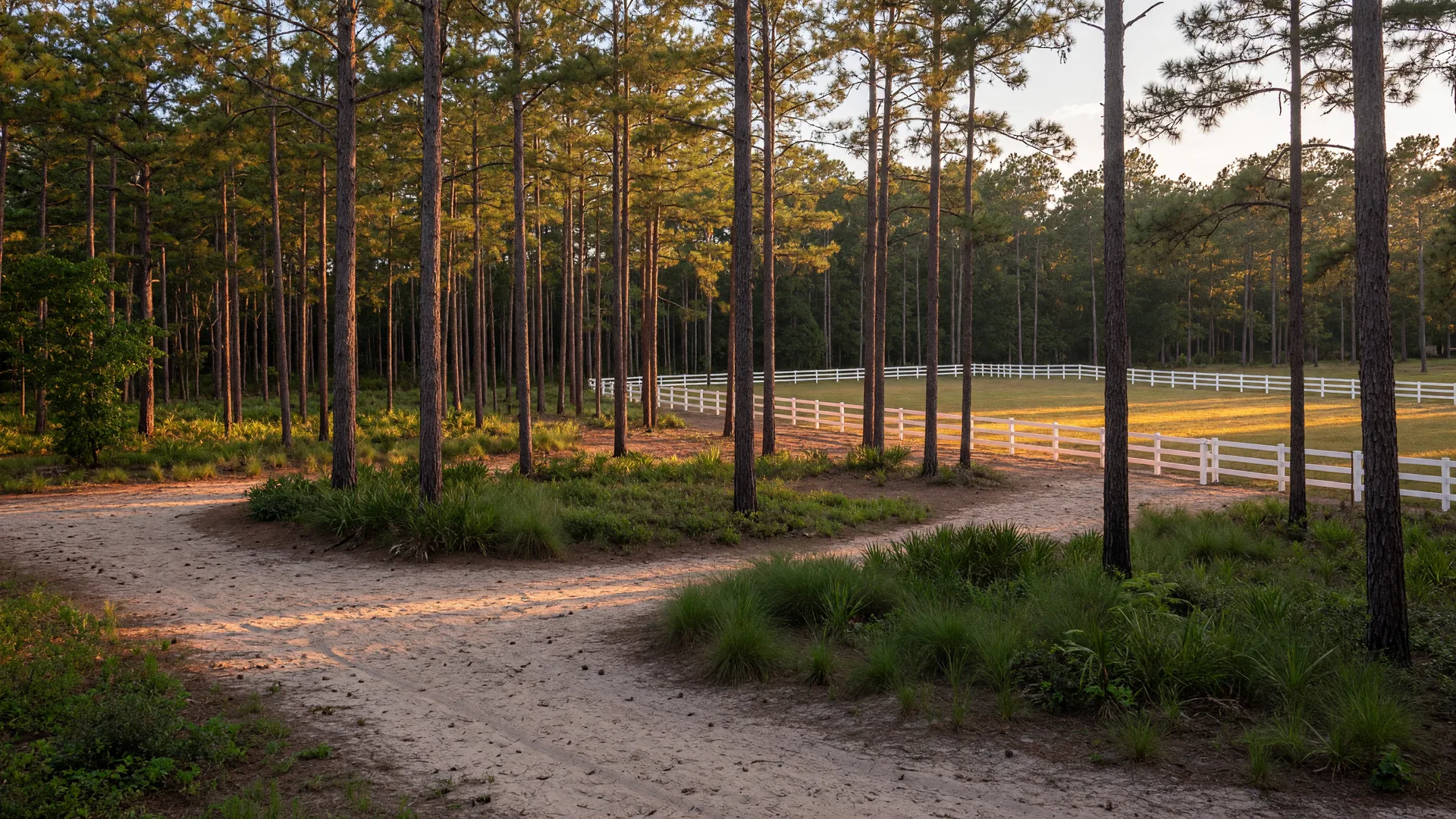
When most buyers start looking at horse properties in Aiken, they focus on the barn, the arena, the fencing, and the house. Those are the visible elements that determine whether a property can support their horses on day one. But over the course of more than 20 years helping equestrian buyers and sellers in the CSRA, I have learned that some of the most valuable horse properties in Aiken County have something else working in their favor. Mature timber, well-managed woodlands, and a smart approach to agricultural tax valuation.
The truth is that many Aiken horse properties include significant acreage beyond the pastures and paddocks. That extra land is often wooded, and when it is managed properly, it can generate income, reduce your property tax burden, and increase the long-term investment value of your property. This guide covers the fundamentals of timber management, agricultural use valuation, and land investment for Aiken horse property owners.
Why timber matters on a horse property
Aiken sits in the heart of the Carolina Sandhills, a region defined by its ancient sandy soil and its longleaf pine ecosystem. The native longleaf pines that grow here are among the most commercially valuable timber species in the Southeast. They produce strong, straight, rot-resistant lumber that commands premium prices in the timber market. Many older Aiken horse properties were originally farmed for timber before the equestrian economy took hold, and the woodlands on those properties still hold significant value.
From a property investment standpoint, timber offers something that few other agricultural assets provide. It appreciates over time while you use the land for horses. A stand of mature pines on the back 40 acres is not just a scenic backdrop for trail rides. It is a standing asset that gains value each year and can be harvested strategically to fund improvements, pay down debt, or provide retirement income.
For buyers evaluating horse properties, the presence of mature timber can be a meaningful negotiating factor. A timber cruise (a professional assessment of the volume and value of standing timber) can reveal tens of thousands of dollars in latent value on a property that appears to be simply wooded land. Conversely, a property that has been recently clear-cut may require 15 to 20 years of regrowth before it produces timber value again, which should factor into the purchase price.
Not all timber is created equal.
Longleaf pine, loblolly pine, and mixed hardwoods each have different growth cycles, market values, and management requirements. If you are considering a property with significant wooded acreage, I recommend having a consulting forester walk the land before you make an offer. That $100 to $200 investment can save you from overpaying for land with low-quality timber or, just as important, help you recognize when a property is priced below its true value because the seller did not realize what the timber was worth.
How agricultural use valuation works in Aiken County
One of the most important financial benefits of owning a horse property in South Carolina is the agricultural use valuation program. Under this program, qualifying land is assessed at its "use value" for agricultural purposes rather than its fair market value for development. The difference can be dramatic. A 20-acre parcel valued at $20,000 per acre for residential development might be assessed at a fraction of that amount when it qualifies as agricultural land.
In Aiken County, land used for agriculture (including the grazing of horses, hay production, and timber growing) can qualify for this favorable tax treatment. The taxable value is calculated at 4 percent of the use value for individual or partnership owners, compared to 6 percent for residential property. When you combine the lower assessment rate with the significantly lower use value, the annual property tax savings on a 20-acre horse property can amount to thousands of dollars per year.
To qualify, property owners must file an application with the Aiken County Assessor's Office demonstrating that the land is being used for a bona fide agricultural operation. The requirements generally include evidence of active agricultural use, minimum acreage thresholds, and in some cases, proof of income from the agricultural activity. For horse property owners, keeping horses on the land and maintaining pastures typically satisfies the use requirement.
Timberland as agricultural use land
South Carolina law specifically classifies land used to grow timber as agricultural use land for property tax purposes. This means that wooded acreage on your horse property can qualify for the same tax benefits as your pastures. The land is taxed based on its fair market value for agricultural purposes, which is generally much lower than its residential or commercial development value.
For timberland, the qualification process may require a forest management plan or evidence of active timber management. Many Aiken County property owners work with consulting foresters to develop and implement these plans. A well-documented management plan demonstrates to the assessor that the land is actively managed for timber production, not merely left to grow wild.
One important note for horse property buyers. If you purchase a property that has been receiving agricultural use valuation, you must reapply for the classification after the transfer of ownership. The previous owner's exemption does not automatically transfer to you. The application deadline and requirements can vary, so it is wise to contact the Aiken County Assessor's Office early in the closing process to ensure continuity of the tax benefit.
Ask about the current tax classification before you make an offer.
When you find a horse property you are interested in, I always recommend asking the seller for the current property tax assessment and whether the land is classified as agricultural use. If it is not, find out why. Some properties with excellent equestrian infrastructure may not have the classification simply because the previous owner never applied. If the land qualifies, getting the classification in place after closing can significantly reduce your annual tax bill.
Ask Linda about agricultural valuationTimber management strategies for horse property owners
Managing timber on a horse property requires a different approach than managing a pure timber plantation. Your horses are the primary enterprise, and the timber management plan needs to complement their needs rather than compete with them. Here are the strategies that work best for equestrian properties.
Selective harvesting over clear-cutting
Clear-cutting removes every tree on a tract at once. For a horse property, this approach is rarely appropriate. It eliminates shade, changes the drainage patterns of the land, and leaves a visual scar that can take a generation to heal. Selective harvesting, by contrast, removes only mature or lower-quality trees while leaving the best specimens to continue growing. This approach preserves the aesthetic and functional value of the woodland while generating periodic income.
Selective harvesting also protects the windbreak and shade that mature trees provide for pastures and paddocks. Horses need access to shade during Aiken's hot summers, and a well-managed woodland edge along a pasture can reduce heat stress significantly. Clear-cutting that edge exposes the pasture to full sun and can make the property less comfortable for horses during the hottest months.
Working with a consulting forester
A consulting forester is a professional who works for you, not for a timber buyer. They will cruise your timber, determine its volume and value, develop a management plan, and solicit bids from multiple timber buyers when it is time to harvest. Their fee is typically a percentage of the timber sale proceeds, and their expertise almost always results in a higher net return than selling directly to the first buyer who approaches you.
For horse property owners, a consulting forester can also advise on how to time harvests around the equestrian calendar. Harvesting during the Winter Colony season, for example, may not be ideal if you board horses or run a training operation. A good forester will work around your schedule and minimize disruption to your horse operation.
Thinning for pasture and trail integration
Thinning is a lighter form of timber management that removes a portion of the trees to improve the health and growth rate of the remaining stand. On a horse property, strategic thinning can also accomplish landscape goals. Opening the canopy along a trail corridor creates a more pleasant riding experience and allows light to reach the trail surface, which reduces mud and extends the riding season. Thinning near pasture edges can improve grass growth by allowing more sunlight to reach the ground, extending your grazing area without expanding your fence line.
Longleaf pine restoration
Longleaf pine ecosystems were once dominant across the Sandhills, but decades of fire suppression and conversion to loblolly plantations have reduced their range dramatically. Restoring longleaf pine on your property is both an ecological investment and a financial one. Longleaf pine is more resistant to disease, wind damage, and wildfire than loblolly. It produces higher-value timber at maturity, and its open, park-like understory is ideal for trailing horses through. Several cost-share programs through the USDA Natural Resources Conservation Service and the South Carolina Forestry Commission can help fund longleaf restoration on qualifying properties.
The role of conservation easements
For owners who want to preserve their land for future generations, a conservation easement is worth exploring. A conservation easement is a voluntary legal agreement that permanently limits the development rights on a property to protect its conservation values. The land remains in private ownership and can continue to be used for horses, timber management, and agriculture. But the development rights are permanently restricted.
The financial benefits of a conservation easement can be substantial. The easement may reduce the property's assessed value for tax purposes, and the donation of the easement to a qualified land trust can generate a significant federal income tax deduction. The Aiken Land Conservancy is the primary organization working on conservation easements in Aiken County and can provide guidance to property owners considering this option.
Conservation easements are not right for every property or every owner. They are permanent decisions that affect what you and future owners can do with the land. But for owners who want to ensure that their horse property remains a horse property forever, an easement is one of the most powerful tools available. I have worked with several clients who included conservation easements in their estate planning, and the peace of mind it provides them is remarkable.
Learn more about Aiken conservation.
For a deeper look at how conservation easements and land trusts are shaping the future of Aiken's equestrian landscape, see my full guide: Preserving Aiken's Horse Country: Conservation, Land Trusts, and the Future of Equestrian Properties.
Land investment considerations for horse property buyers
When you buy a horse property in Aiken, you are making a land investment whether you intend to or not. The land under your barn and pastures has its own value trajectory, independent of the structures on it. Here are the factors that matter most for long-term land investment in Aiken County.
Location relative to the Horse District
Aiken's Horse District zoning protects the equestrian character of certain areas and imposes minimum acreage requirements for subdivision. Properties inside the Horse District tend to hold their value better than those outside it because the zoning limits development pressure and preserves the rural, equestrian character that buyers seek. If long-term land appreciation is a priority, being inside or adjacent to the Horse District is a significant advantage.
Water access across the property
Land with access to municipal water is generally more valuable than land that depends entirely on wells, but in Aiken's rural horse country, well water is the norm. The depth and yield of existing wells, the number of wells on the property, and the quality of the water all affect land value. Properties with multiple wells (one for the house, one for the barn) are more resilient and more attractive to buyers. The ability to add irrigation to pastures and arenas also adds value, especially during Aiken's dry summer months.
Soil quality and drainage
Aiken's sandy soil is one of the region's greatest assets for horse properties. It drains quickly, which means less mud, healthier hooves, and more rideable days per year. But not all sandy soil is the same. The depth of the sand, the underlying clay layer, and the drainage patterns across the property all affect how well the land supports horses and pastures. A soils map from the USDA Natural Resources Conservation Service can tell you a great deal about a property's agricultural potential before you ever set foot on it.
Proximity to trail networks
Access to riding trails is one of the strongest value drivers for Aiken horse properties. Properties that back up to Hitchcock Woods, the GAIT trail system, or the Palmetto Trail are highly sought after. Trail access does not just enhance the lifestyle value of a property. It directly affects its marketability and resale value. If you are looking at a property that does not have direct trail access, consider whether the land could support building your own trails or whether there are future trail connections planned.
Bringing it all together
The best Aiken horse property investments are the ones that work on multiple levels. The barn supports the horses today. The pastures provide grazing and turnout. The timber appreciates quietly in the background, generating tax savings through its agricultural classification and providing periodic income through strategic harvests. And the land itself, protected by thoughtful zoning or a conservation easement, holds its value for the long term.
I have helped dozens of buyers evaluate these factors when purchasing horse properties in Aiken, and I have seen firsthand how a property that might look similar to another on paper can be a dramatically better investment when you understand what is happening in the woodlot, the tax assessor's office, and the conservation easement file. If you are considering a horse property purchase in Aiken and want to understand the full picture of what you are buying, I would welcome the chance to help.
Let Linda help you evaluate the full picture.
With more than 20 years of experience in Aiken, North Augusta, and Augusta real estate, I know how to evaluate horse properties from every angle. Contact me or schedule a consultation to discuss your goals.
Schedule a Consultation