
Trailer Parking and Hauling on an Aiken Horse Property: The Gates, Driveways, and Turnarounds That Make Show Season Easy
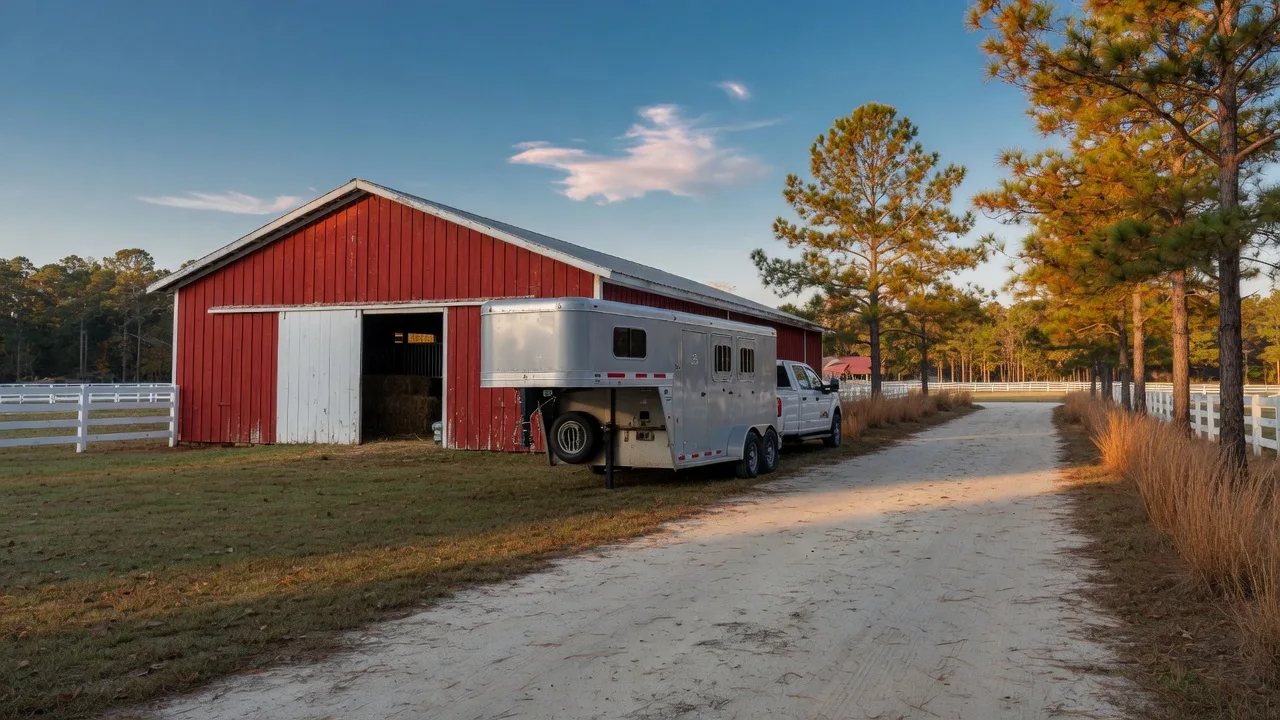
When horse people tour a farm, the barn gets the attention. The stalls, the aisle, the tack room, the arena, everyone looks at those first. But in the fall, as the Winter Colony arrives and the show season picks up, the quietest and most used feature on an Aiken horse property is often the one nobody thinks to measure: the route in and out for a truck and trailer. Whether you haul to Bruce's Field on a Saturday morning, ship horses in for the winter, or simply want to know the vet and farrier can pull in without a scene, how a property handles a trailer determines how easy your horse life will actually be. Here is what to check when you tour, and why the driveway matters as much as the barn door.
After more than 20 years of helping buyers find horse property in the CSRA, I have stood at the end of more driveways than I can count, mentally backing a rig in. A great barn on a tight, awkward entrance is a daily frustration. A simple, well-planned entrance turns every haul into a non-event. This guide walks through the features that make a property genuinely trailer-friendly, from the gate at the road to the parking pad beside the barn.
Why hauling matters more in Aiken than almost anywhere else
Aiken's equestrian calendar is built on horses that travel. The Winter Colony season brings Thoroughbreds, eventers, and jumpers into the area every fall, many of them shipped in from colder states and hauled between training barns and the competition grounds all winter. Local competitors head out to Bruce's Field, Stable View, and Whitney Field on a near-weekly basis. Even a purely recreational owner trailers to hunter paces, group trail rides, and lessons at least now and then.
A property that cannot comfortably accept a truck and trailer makes every one of those trips harder than it needs to be. A gate too narrow to swing through, a driveway with a tight curve, an entrance that forces a three-point turnaround on a public road, these are the small things that turn a simple haul into an argument with a trailer. They are also, once you have lived with them, the things you cannot unsee. Buyers who plan to compete, board visiting horses, or host friends with trailers should weigh hauling access heavily in the search.
The gate and the entrance: how wide is wide enough?
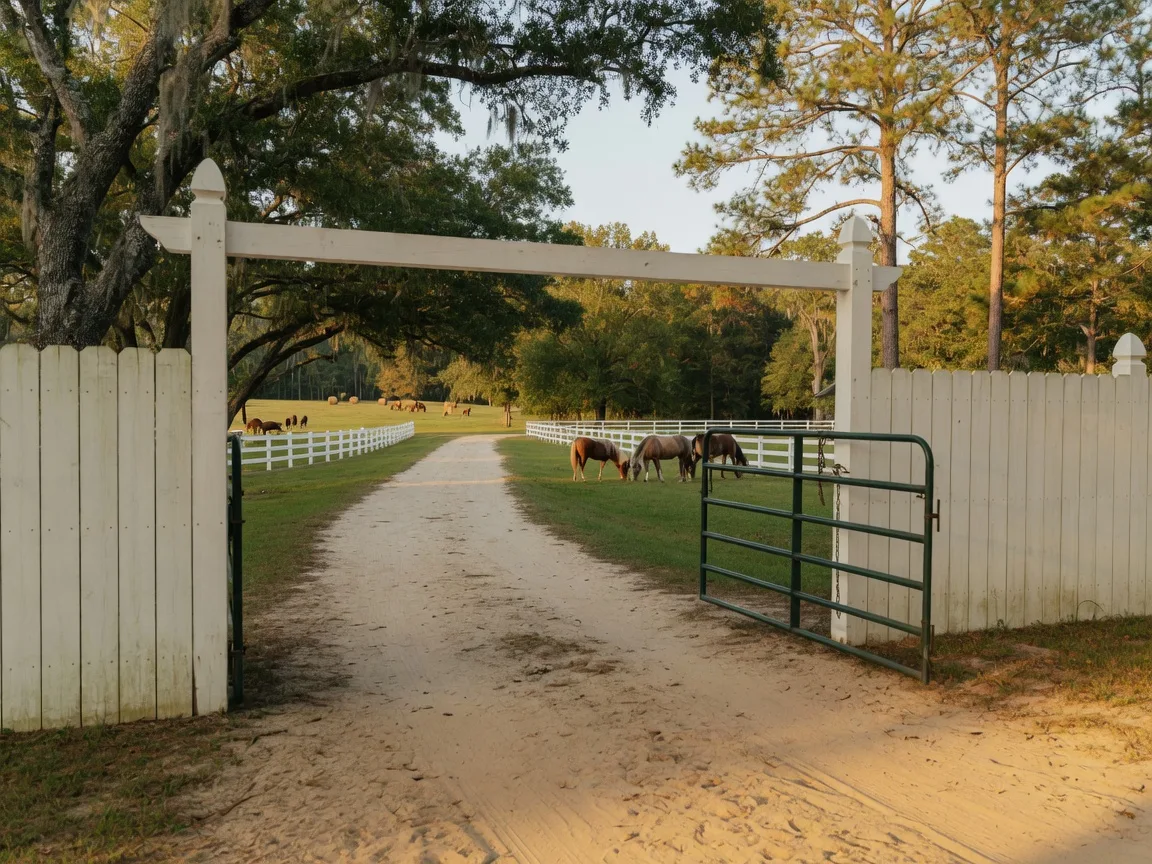
The gate at the road is the first test of a trailer-friendly property, and the numbers are surprisingly specific. A two-horse bumper-pull rig is roughly eight feet wide and can run twenty feet or more in length, and a gooseneck with living quarters stands eleven to thirteen feet tall. For a truck and trailer to enter safely, a twelve-foot gate is the practical minimum, and fourteen feet is better because it clears most farm trucks and lets a rig pivot cleanly. When the approach involves a turn or the vehicle must swing wide from the road, sixteen to twenty feet is the safer call. If a property has room, a twenty-four-foot main gate is the recommendation for serious farm use, with extra clearance on each side if the gate sits on a curve.
Just as important is the walk-through gate. A thoughtful farm keeps a separate four-foot gate for people and wheelbarrows, so you are not opening a twenty-foot vehicle gate every time you walk the fence line. It is a small detail, but it tells you the current owner actually works the property, and it saves you from installing one yourself.
The driveway: straight, level, and clear overhead
Once through the gate, the driveway does the rest of the work. Keep the approach straight near the gate, because trailers cut corners, and the straighter the first fifty feet, the easier the whole entrance. A level driveway also matters. A rig backing up a slope with a horse on board is a bad combination, and even parked trailers sit more happily on level ground.
Vertical clearance is the hidden one. Most trailers stand seven to eight feet tall, and living-quarters units run eleven to thirteen feet. Low-hanging branches, utility lines, or a decorative arbor can turn a fine driveway into a dead end for a tall rig. Plan for about fourteen feet of clear height and look up on every tour, not just at the gate but all the way to the barn.
Turnaround room: can you actually turn around?
Backing a truck and trailer down a long driveway in the dark after a show is nobody's idea of a good time, so a proper turnaround is a genuinely valuable feature. A circular or hammerhead drive needs a minimum turning radius of roughly fifteen feet, with about twelve feet of drive width through the curve, and a full one-hundred-and-eighty-degree turnaround needs a clear circle of about one hundred to one hundred and twenty feet in diameter. That sounds like a lot, and it is, which is why the best farm drives are often a simple loop or a wide hammerhead at the barn end.
Think about emergencies too. Fire apparatus, feed trucks, and an ambulance all need to get in and out. A property that can turn around a gooseneck can usually turn around anything, and that peace of mind is worth a good deal when you are standing at the top of a long drive at midnight.
Bring your rig to the tour.
If hauling matters to you, do not guess. Bring your own truck and trailer to the property and drive the route you will actually drive. Measured numbers are helpful, but the honest test is backing in yourself. I am happy to arrange the extra time on any tour so you can see exactly how a property handles.
Trailer parking and the wash bay
Where the trailer lives when it is not moving matters as much as where it drives. A level, well-drained parking pad beside the barn keeps a rig out of the mud and the sun, and in Aiken's sandy Sandhills soil, drainage is rarely the problem it is in heavier clay country. A gravel pad is the standard, easy to maintain and kind to tires and boots alike.
Look for a wash rack or wash bay with hot and cold water and good drainage, because horses come home from a cross-country course or a muddy hunter pace needing a bath, and you do not want to drag that mess through a stall aisle. A hose bib and a power outlet near the trailer parking area make washing the rig itself far easier. If you plan to host visiting horses, confirm that the water and power reach where a second rig might park.
Location: how far is the nearest ring?
The best driveway in the world cannot shorten a long haul. Where the property sits relative to the venues and trails you use most is the other half of the equation. A property within a short trailer ride of Bruce's Field, Stable View, or the training track changes how often you compete and how much of your weekend disappears on the road. When competitive access matters, I factor the drive times into every property we consider, because the difference between a ten-minute haul and a ninety-minute haul is the difference between a regular show schedule and a rare one.
This is the kind of feature that is easy to overlook on a pretty first tour and impossible to ignore after a season of use. Gate widths, straight approaches, overhead clearance, turnaround room, and a dry place for the rig, together they are the difference between a farm that works for horses and a farm that simply has horses on it.
Let's find a property that hauls well.
Whether you compete every weekend, ship horses in for the winter, or just want the vet and farrier to pull in easily, I can help you find the Aiken property that fits. Contact me to start the conversation.
Contact Linda